 |
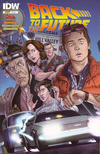
"Looking for a Few Good Scientists"
Back to the Future #1
IDW
Story by Bob Gale
Script by Erik Burnham
Art by Dan Schoening
Colors by Luis Antonio Delgado
Letters by Shawn Lee
October 2015 |
A piece of Doc Brown's scientific past is
revealed in 1943.
Read the story
summary at
Futurepedia
Notes from the Back to the Future chronology
This story takes place in 1943.
Characters appearing or mentioned in this story
Dr. Emmett Brown
Dr. Robert Millikan
Vannevar Bush
Major General Leslie Groves
Mrs. Gomez (mentioned only)
J. Robert Oppenheimer
Didja Notice?
This story opens at the California Institute of Technology
in 1943, where Dr. Emmett Brown is teaching. Popularly known
as CalTech,
the
California Institute of Technology
in Pasadena, CA is known for its strong sciences and
engineering curriculum. The building shown on page 1, panel
1 is the East Norman Bridge Laboratory of Physics on the
university campus.
The man Doc talks to on pages 1
and 2 is Dr. Robert Millikan (1868-1953). He was an American
physicist who won the 1923 Nobel Prize for Physics and was
the first president of CalTech from 1920-1946. Millikan is
here seen perusing The New Heavens by George Ellery
Hale. This is an actual book about the history astronomy
published in 1922. Hale (1868-1938) was an American solar
astronomer.
When Dr.
Millikan asks Doc why he's not in
his classroom teaching at the moment, Doc tells him he has
the class working on the Jacobian conjecture. The Jacobian
conjecture is a famous unsolved problem in mathematics.
At this time of his life, Doc lives in an apartment in the
Pasadena area.
On page 3, Major General Leslie Groves
finds a copy of the Encyclopedia of Needlework by
Thérèse de Dillmont in "Doc Brown's apartment." This is an
actual book first published in 1886 and still in publication
today. Dillmont (1846-1890) was an Austrian needleworker and
writer with a number of books to her credit.
It is interesting to note that Dillmont worked for
the French textile company
Dollfus-Meig
et Cie, which also published books of textile patterns
and her encyclopedia. The company is often known as DMC, the
same shorthand as the
DeLorean
Motor Company!
On page 4, Vannevar Bush accidentally steps on Mrs. Gomez's
mail, including an issue of
Good Housekeeping magazine.
Also on page 4, Doc walks past several
storefronts in downtown Pasadena: Reliable Radio, Fox
Pasadena Theatre, and Schwab's Pharmacy. Reliable Radio and
the Fox Pasadena Theatre were actual businesses in the city
at the time. I've been unable to confirm Schwab's Pharmacy
existing in Pasadena, but there were a few in the Los
Angeles environs.
The Fox Theatre is showing a matinee of Time
Flies, starring Dall, Handley, and Moon. This was an
actual film, a British comedy starring Evelyn Dall, Tommy
Handley, and George Moon, ironically about a time machine
trip to the Elizabethan era (1558–1603). Unfortunately, the
film is out of place here unless it travelled back in time
itself; it was not released until May 1944 in the UK and not
seen in the U.S. as far as I can tell until it was shown on
television in 1950.
On the last panel of page 4, two portraits are seen
hanging on the wall of Doc's apartment. They are also seen
in Doc's house in 1955 in Back to the Future. The
top portrait is Sir Isaac Newton
(1642-1727), a key player in the Scientific Revolution and
best known for his mathematical theorems on the nature of
gravity. The bottom portrait is clearly Benjamin
Franklin (1706-1790), famous American polymath and
scientist.
There is also a hat in the same style as the one Doc wears
in 1955. |
 |
On page 5, many of the same items seen in
Doc's apartment here are later seen in his 1955 home in
Back to the Future: a stuffed marlin, a globe, a saxophone
(does Doc play?), and a Kit Kat Klock.
Several clocks are seen, but they all
show different times (in contrast to the plethora of
perfectly synchronized clocks in his home at the beginning
of Back to the Future).
A copy of the Hill Valley Telegraph
newspaper lies on the floor, which seems kind of odd
considering he's not in Hill Valley at this time. Still, his
family home is in Hill Valley, so this may be an old copy he
brought with him. The Hill Valley Telegraph is, of
course, a fictitious newspaper, as is the town of Hill
Valley itself.
A stack of records is seen in a Western Fruit Sales
crate. Western Fruit Sales was an actual company at the
time. One of the record sleeves has "Bluebird" printed on
it; this is probably from the Bluebird Records label, a
budget label of RCA-Victor at the time, known for it blues
and jazz releases.
In the bottom left corner of the page, a copy of the
novel Twenty Thousand Leagues Under the Sea by
Jules Verne is seen. This is a real world novel originally
published in 1870. In Back to the Future Part III,
Doc reveals to Clara Clayton that he's a big fan of the
works of Verne.
Mrs. Gomez is Doc's landlady in Pasadena.
On page 6, J. Robert Oppenheimer welcomes Doc to the
Manhattan Project. The
Manhattan Project was the U.S. research program during WWII
that produced the world's first atomic bomb.
Oppenheimer (1904-1967) was the head of the Manhattan
Project and so-called father of the atomic bomb.
After being invited to join the
project, Doc wants to mark the occasion with his guests with
something he says he's been saving...a plate of
Jell-O with a
mushroom in the middle of it. An odd way of celebrating, but
Doc is an unusual guy. The mushroom in the Jell-O must
represent the mushroom cloud of an atomic explosion, so he
must have, through his research on the top secret project,
figured out it was geared towards producing an atomic bomb.
 |
Notes from the
DeLorean Time Machine: Doc Brown's Owners' Workshop
Manual
(The page numbers come from the 1st
printing, hardcover edition, published 2021) |
| Doc Brown's journal entry of May 14, 1946
states that he has been hired by King Class Technologies on
a classified assignment. This appears to be a fictitious
company. Doc's entry also states that two redacted names
whom he worked with in Los Alamos were also hired there.
This may be a reference to Kenneth Bainbridge (the director of
the Manhattan Project's Trinity nuclear test) and
Oppenheimer. Doc also has a sketch of a group of
scientists he would likely have worked with
at the
Manhattan Project (from September 1945): Kenneth Bainbridge,
Joseph Hoffman (I'm unsure if this is meant to be an
historic figure), J. Robert Oppenheimer, Louis Hempelmann (a
researcher of radiobiology for the Manhattan Project),
Victor Weisskopf (an Austrian-born American theoretical
physicist), Robert Bacher (an American nuclear physicist),
and Richard Dodson. The sketch is actually based on a real
world photo of these men (plus Doc himself drawn into the
back row). |
 |
| |
| |
 |
Doc's employment at King Class Technologies was terminated
on May 27, 1949 due to his repeated violations of the dress
code (Hawaiian shirt under his lab coat).
Back to Back to the Future
Episode Studies